Plastic stools look simple. Molding them well takes real engineering. They are large, they carry human weight, and buyers expect years of use.
Most stools are molded from PP, often a copolymer grade with good impact resistance. PP flows well and resists fatigue from repeated loading. HDPE is the backup where extra cold toughness matters.
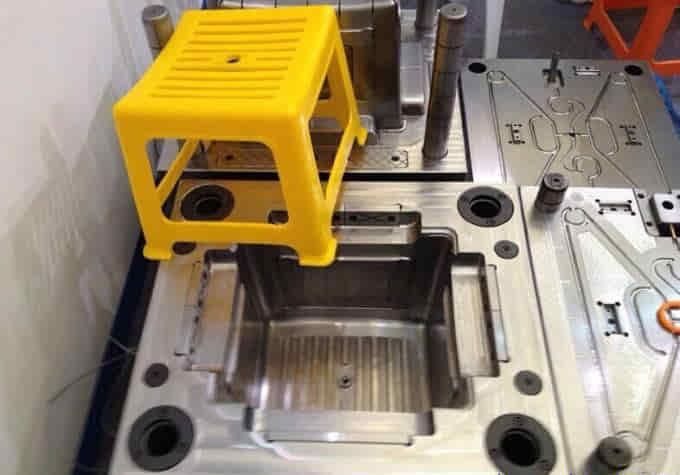
Large Single-Cavity Molds
Most stools come from large single-cavity molds. A typical stool mold spans 600–800 mm and weighs several tons. The part is large, so the mold needs a high-clamp press. Most stool molds run on 400T to 800T machines.
The mold must fill evenly. Thick legs and a wide seat need a balanced feed, or plastic arrives late in some areas. Put gates where weld lines will not weaken the legs. A mold-flow simulation before steel cutting confirms fill balance and weld-line spots.
Single-cavity tooling stays simpler and more reliable than multi-cavity at this size.
Choosing Mold Steel
Stool molds run long volumes. Steel choice matters. P20 and 718 are the industry standard pre-hardened steels. They machine well, polish well, and resist wear in PP and HDPE.
Stool seats often carry a light texture for grip and to hide scuffs. P20 and 718 take texture etching well. The grain stays consistent across the seat.
Protect the cooling channels against corrosion. Water eats untreated steel over years of running.
Stack Molds for High Volume
Very high volumes can justify a stack mold. Two parting lines sit back to back. The mold makes two stools per cycle on a slightly larger machine.
Stack molds cost more to build. The hot runner and ejection need careful design. But for large stable orders, the lower part cost pays back fast. Share your real volume forecast before choosing.
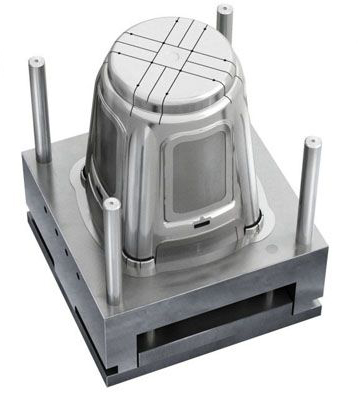
Nesting and Stackable Design
Stools must stack for shipping and storage. Most designs nest. Each stool fits partly inside the one below, which saves container space.
Nesting needs precise taper angles on legs and seat. Too little taper and stools jam. Too much and the stack turns wobbly or the stool looks bulky.
Verify stackability before cutting steel. A 3D check helps. A physical stack of sample parts proves it. Buyers skip the stack test. Then a full container of stools will not unload.
Gas-Assisted Molding as an Option
Stool legs are thick. Thick sections sink and cool slowly. In gas-assisted molding, nitrogen follows the plastic into the thick areas. The gas hollows the section from inside.
This cuts material use and shortens cooling. Sink marks fade. The catch is extra hardware. The mold needs gas channels and tight process control. That adds cost to the tool and the press setup.
For most standard stools, a conventional mold with solid ribs does the job cheaper.
Cooling and Ejection
Cooling sets cycle time. Ejection sets part quality. Channels that follow the seat contour cool the most evenly. Even cooling stops warpage. A warped stool wobbles.
Even cooling also holds shrinkage in check. Legs stay in tolerance. The stool sits level. For ejection, use a balanced layout or a stripper plate. The big part must release without distortion. Keep ejector marks on hidden faces. Eject only when the part is rigid enough to hold its shape.


Leave a Reply