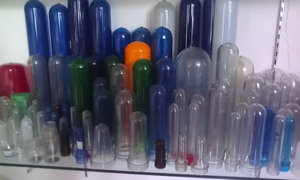
PET preform molding turns PET resin into the small tubes that become bottles. The process looks simple. It demands tight control at every step.
Drying the PET Resin
PET drinks moisture from the air. Wet resin makes haze, bubbles, and weak bottles. Dry PET at 160–175°C for 4–6 hours. Target moisture below 50 ppm.
A dryer with a dew-point monitor is essential. Never skip or shorten drying. We check the dew point every shift. Wet resin is the top haze cause we see.
Temperature Control
Barrel and hot runner temperatures need precision. Most melt heat comes from screw shear, not the heaters. Set temperatures to the resin supplier’s numbers. Then verify against actual melt temperature.
One cold nozzle shows up as light preforms in that cavity. Check each zone, not just the average.
Injection and Packing
Injection pushes melt through flow resistance into the mold. A three-stage speed and pressure profile works best, set in descending order.
Slow injection lets the melt cool before filling ends. The result is short shots. Fast filling with poor venting traps air. Parts shrink.
Packing stops melt backflow and cools the part under pressure. Too much packing pressure makes flash and high stress. Crystallization follows. Too little gives shrinkage, voids, and gate deformation.
Gate blush usually means the first-stage speed is too high. Back it off.
Pressure Release and Back Pressure
After packing, back the hot runner pressure down a little. This stops gate drool and valve sticking. Release too much and voids appear.
Back pressure applies during screw recovery. It improves plasticizing and pushes out air bubbles. Start low and raise it until bubbles disappear. Too much back pressure overheats the melt and can block the gate.
Drool strings at the gate mean the release was set too light. Add a touch more.
Cushion Size
The cushion is the melt left ahead of the screw after injection. Too little gives wild shot-to-shot variation. Too much lets PET cook and degrade.
Adjust from small to large. Stop when preforms come out clear, with no whitening. A wandering cushion often means the non-return valve is worn.
Cooling
Fast cooling is what makes preforms transparent. Slow cooling lets crystals grow. Then come shrinkage, deformation, and long cycles.
Keep water treated and lines clean. Check flow and pressure on a schedule. Clean cores and cavities too. Scale in the lines is a quiet killer. We descale on a fixed schedule.